Moons you can hear, see and dance to.
Jupiter's moons keep a rhythm. Io, Europa and Ganymede move in a 4:2:1 beat, and that beat heats their interiors, feeds Europa's thin oxygen atmosphere, and fills Jupiter's space with plasma. Scroll down and each piece below teaches one step of that story, in records, dance, watercolor and music.
Chorus of the Moons: Life Machine
An art and science listening installation by David Delgado Studio and the Life Machine Collective: the voices of Jupiter's 101 moons, played through a field of 101 record players, one record for each moon. Gravitational, magnetic, plasma and resonance data from public NASA datasets become custom records and a multichannel composition, with the Io, Europa and Ganymede 1:2:4 Laplace resonance as the guiding structure.
The collective: Shane Myrbeck (Arup SoundLab) and Emily Shisko for sound; David Delgado for visual form; ONNA (Coco Reilly and Sophie Delila Baudry) for ocean ecology; and for science and data, Apurva V. Oza with Rishi Verma (NASA JPL, Tablāge).
Oza also collaborates with science-artist Rishi Verma (Tablāge), a data architect at NASA JPL and a tabla player.
Visit Chorus of the Moons ↗ About David Delgado ↗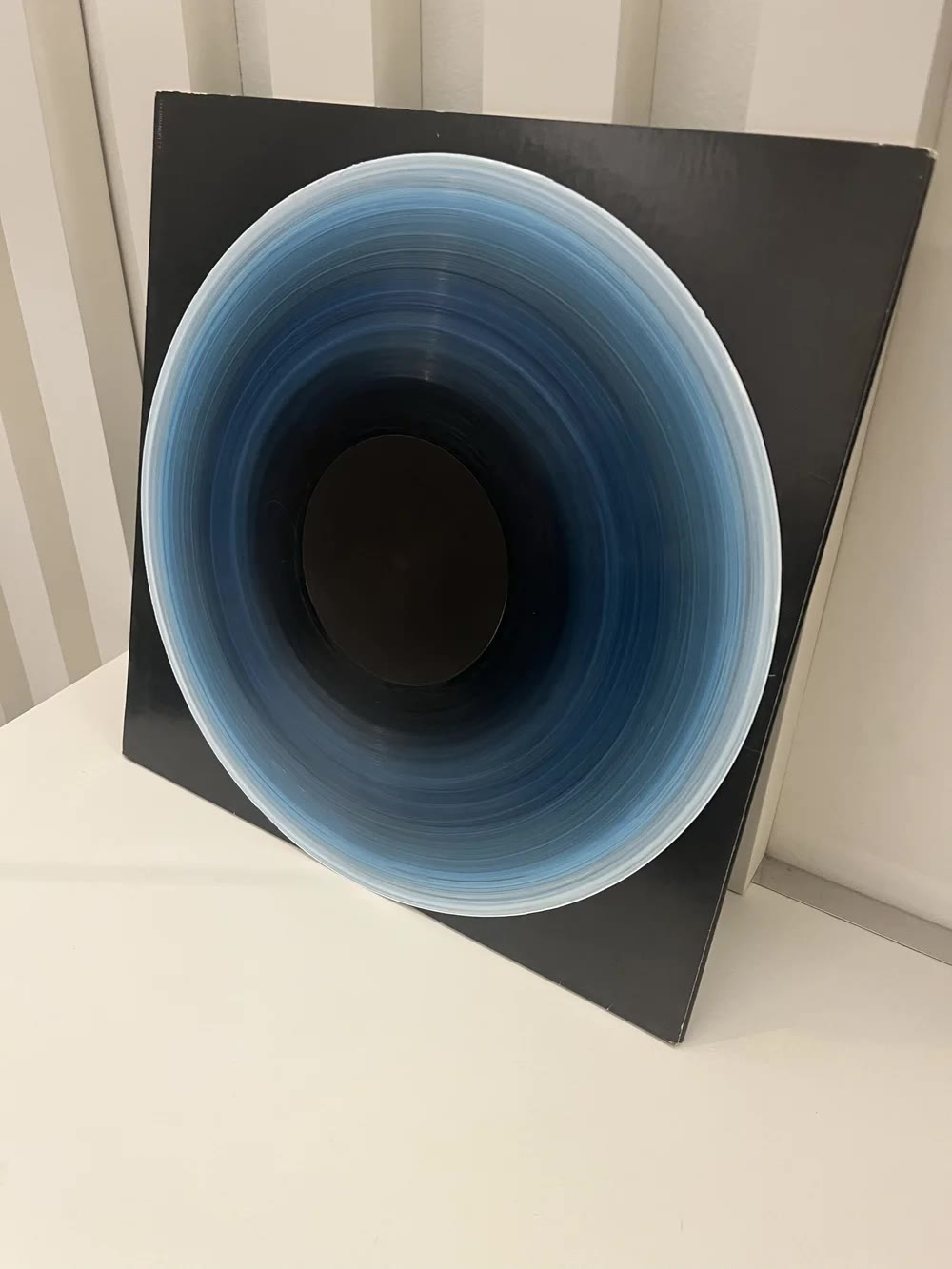
Why a record for every moon?
A moon's orbit is a period, and a period is a tempo. Io circles Jupiter in 1.77 days, Europa in 3.55 days and Ganymede in 7.15 days. Play those periods as rhythms and the three inner moons lock into one groove, each bar of Ganymede holding two of Europa and four of Io.
Credit: Chorus of the Moons, Life Machine, David Delgado Studio and the Life Machine Collective.
The Laplace resonance, in four steps
Three moons, one beat
For every orbit of Ganymede, Europa orbits twice and Io four times. The animation beside this text runs at that 4:2:1 ratio: watch the counters.
Pulls that never cancel
Because the moons meet each other at the same places again and again, their small gravitational tugs add up instead of averaging out. The orbits stay slightly oval.
Oval orbits flex the moons
On an oval orbit a moon's distance from Jupiter keeps changing, so Jupiter's tide squeezes and relaxes it every orbit. That flexing heats the inside: Io becomes the most volcanic body in the Solar System, and Europa keeps an ocean liquid under its ice.
Volcanoes feed the plasma, the plasma feeds the oxygen
Io's volcanic gas becomes charged plasma that sweeps around Jupiter and strikes Europa's icy surface. The hits split water ice and release O₂, a thin oxygen atmosphere. That chain, from resonance to oxygen, is what the dance below performs.
Real periods 1.77, 3.55 and 7.15 days, shown here as 4, 8 and 16 seconds.

O₂ "Panga" on Europa
A bhangra rendition of the thesis, filmed in Paris. Act I sets the Sun hosting a party for its planets. Act II brings in Jupiter's plasma, its tides, and the Laplace resonance you just watched. Act III follows Europa's oxygen as it gathers at dusk, and the finale brings in the instruments on a Paris rooftop.
Watch the full film ↗ Act II clip (sharper)How Europa's ice makes oxygen, painted
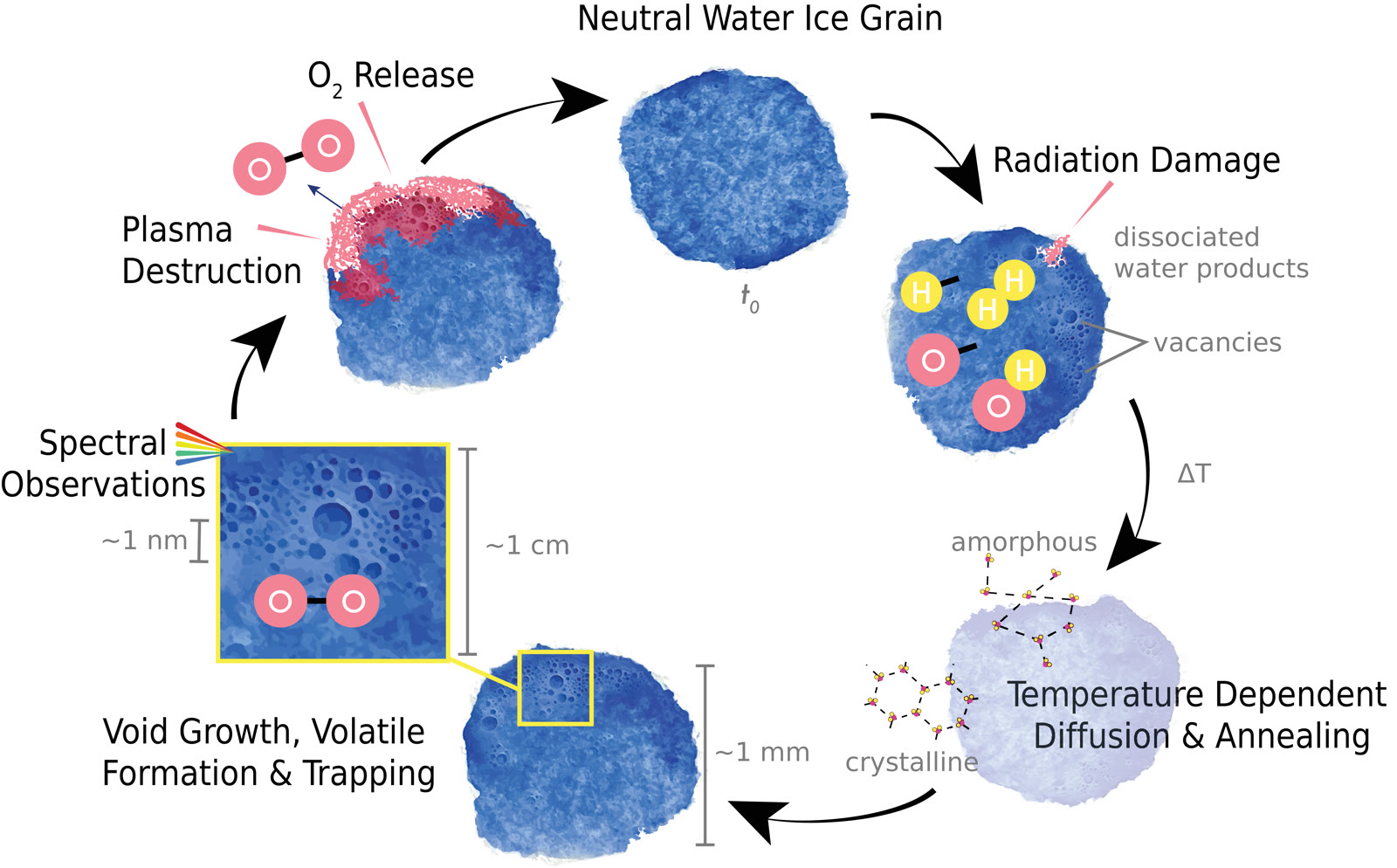
A clean grain of ice
Start with a neutral grain of water ice on Europa's surface.
Radiation breaks the water
Charged particles from Jupiter's plasma split water molecules and leave vacancies in the ice.
Heat lets the pieces move
Depending on the temperature, the fragments diffuse and the ice anneals from amorphous toward crystalline.
Bubbles grow and trap gas
Voids grow and trap new volatiles such as O₂, the oxygen a telescope can measure in the spectrum.
The plasma lets it go
Plasma erodes the grain and releases the O₂ into Europa's thin atmosphere, and the cycle starts again.
A star, a planet and a volcanic moon, driven by a garba
SERPENS is the Monte Carlo code that follows gas escaping an evaporating exomoon. The EuroPaOzaPro renderer borrows its scene, a star, a planet and a moon wrapped in a torus of escaping gas, and lets the music drive the physics.
Bass inflates the torus
Low frequencies puff up the moon's cloud of escaping gas, the way a stronger source fills a real torus.
Percussion is volcanism
Every drum hit raises the volcanic mass flux, so the dhol and dandiya beats throw out bursts of particles.
The key sets the colour
The musical key, read live on the Camelot wheel, tints the torus, ring and atmosphere.
Europa under the ice, and the planet with no star
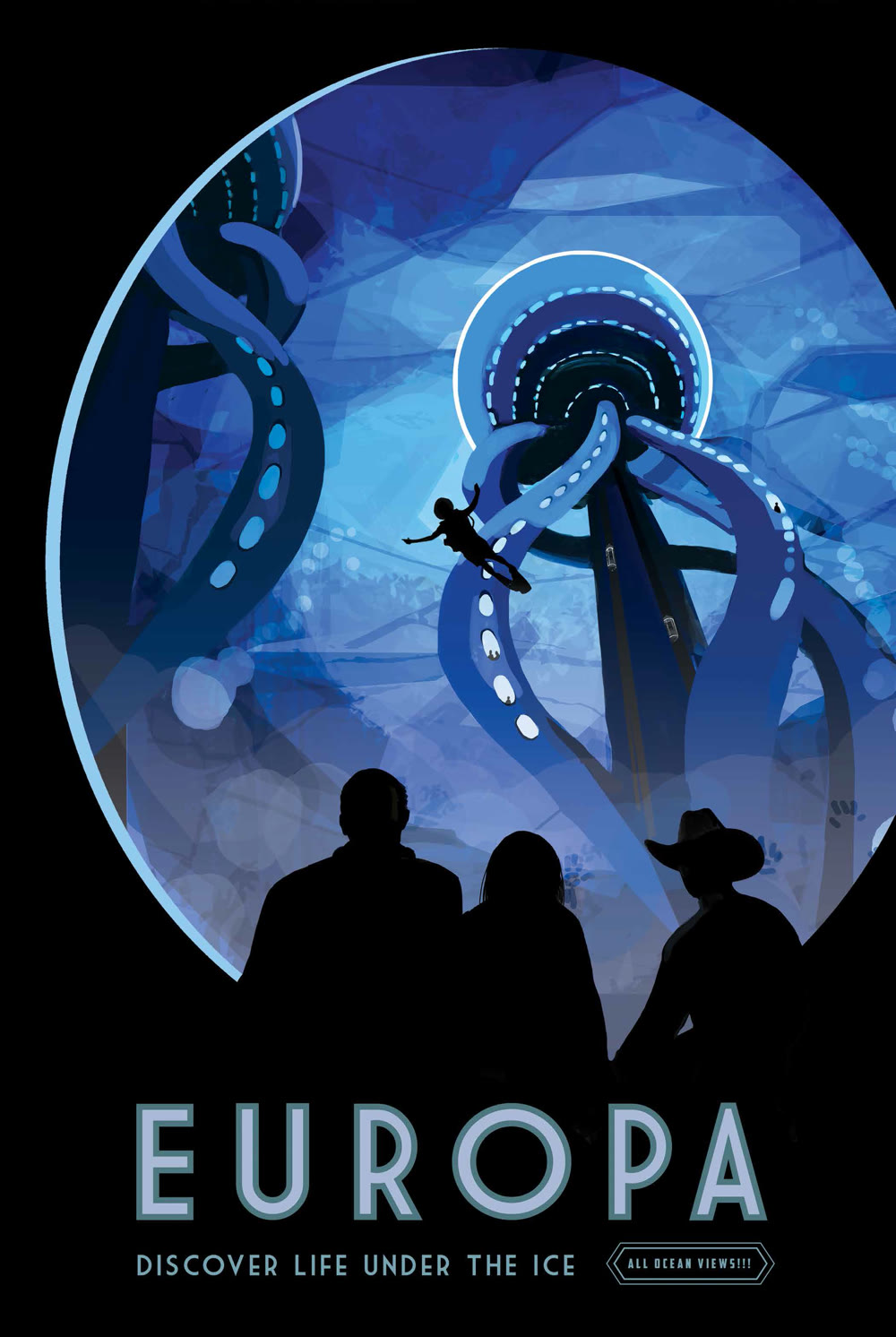
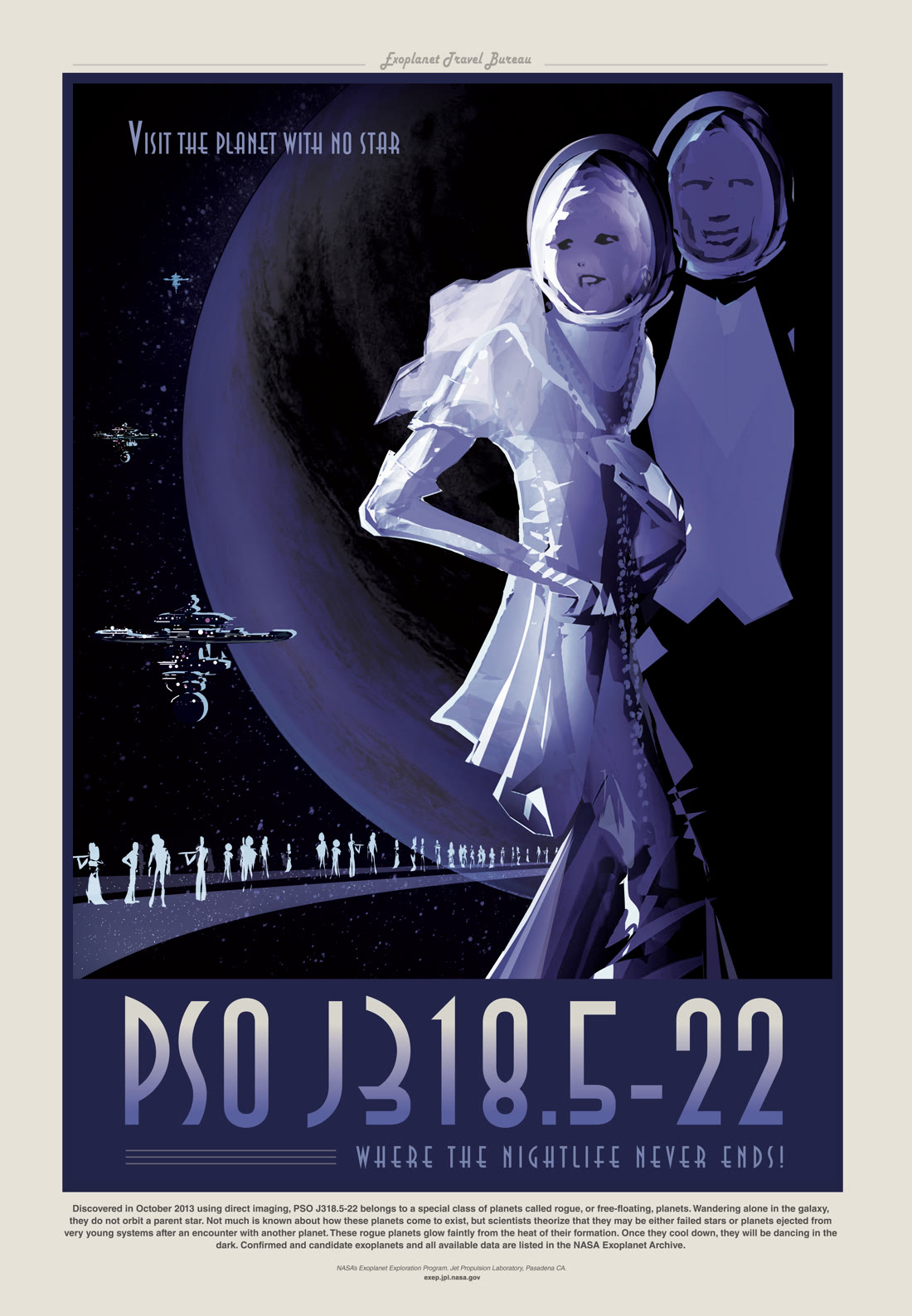
These images are shown with credit as inspiration; they do not imply any endorsement by NASA, JPL or Caltech. See the space-themed weddings at EuroPaOza Weddings.
La Bande: mini mixtapes on 90s cassettes
Short two-song mixes from the Space Panga sets, each on its own cassette, and Rembobiner, the story from a university dhol team to Paris Panga and Space Panga.